Challenge 12 of 52: Cheese Powder Packaging

Few weeks back, Mr. Haris Faizal come to me for some business advice. He's also one of RoketSMS early customers. His product is an instant Cheese Powder and below is his current packaging.


So, what are we going to do with this packaging? Mr. Haris aims to double his sale and design is one of the area to be tackled. He reported that a number of grocery shops rejected his product because of the lackluster design.

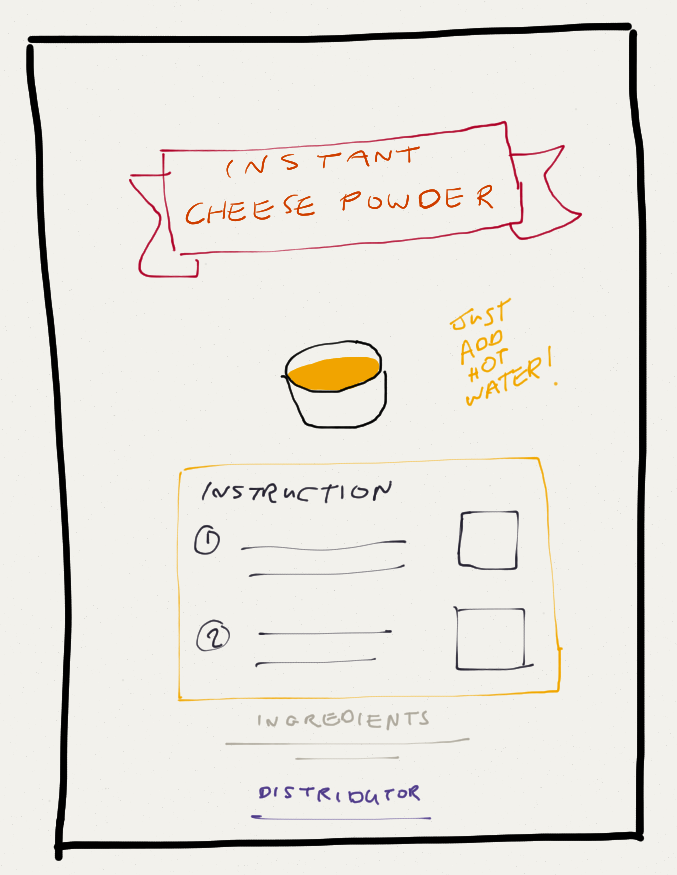
Changing the packaging from simple plastic pack to box is too expensive for him so we need to work around the sticker. The current design is too cluttered so the first thing to do is to bring some visual hierarchy to the design. Lower part of the current design looks like a mass of nonsensical text due to the use of same font size for all type of information. The instruction, ingredients, distributor information and expiry date is all jumbled up together.

The obvious thing to do is to make the Ingredients section smaller because it is there just for compliance sake. Focus should be given to the instruction because there lies the value proposition of the product. Consumers are buying convenience here so the packaging need to sell how easy it is to prepare the cheese dip.

This is further reinforced from customer frequent question which is do they need to cook it on the stove? Actually, they just need add hot water. Thus, the instruction should be made crystal clear and hightlight 'Just Add Hot Water'. Also, change the name of the product to Instant Cheese Powder for good measure.


Challenge 11 of 52: Error Handling in RoketSMS

As a designer, we usually fall trap into two kind of oversight. First, what we thought was important is not important to the users. Secondly, things that we thought will not go wrong will go wrong in the hands of the user.

I think I've sorted out the first oversight last week so this week I'll drill down the second oversight. As the designer of the web app it seems really obvious that the message limit is 160 characters and you need a valid phone number to send the message to. So, during my tests I skip over these two scenario.

Then come real users and the errors crops up. The problem is that error message given by the system is unhelpful. The error is the same no matter what causes them - either a crashed database or simply an invalid phone number. This causes distress to customers especially since they stand to lose precious SMS credits.


The top two error is that the message is too long and invalid number. There's two ways to manage errors; first is to prevent the error from happening and secondly give more helpful information. One is proactive while the later is more reactive.
Preventing the first error is straight forward. Just put a character counter and disable the send button once the limit is crossed. For the time being I ask users to check character count at http://www.charactercountonline.com/


For the second error, a delivery report function should be implemented. This will help users to identify the faulty record and delete it.

Another week, another challenge completed. I think I'm going to look into food & beverages in the coming weeks.

Challenge 10 of 52: New Features for RoketSMS

Double digit! At last! Alhamdulillah, still managed to maintain the momentum. Now, I'm almost 20% through the project.

RoketSMS have started to have paying customers. Most are strangers that come from FB Ads. Only one is a friend that pay in person. After they had been using it for a few weeks, I emailed them to vote for new features to be included in the next version.

Many replied the survey promptly and here's the result for the top two feature request:
  1. Contact groups
  2. SMS customization
So, I get to work and design the UX for version 2. For the contact groups I decided to implement via tabs since that's a familiar approach for anyone that use modern browsers. Certainly it will suitable in a web app.


As for SMS customization, I decided to reduce the probability of error. Rather than introducing markup codes to be inserted manually by the users, it will be easier to choose from a drop down menu. This will reduce error probability and saves us from adding a preview function for the time being. 
Looks like my hypothesis about user requirement is off the mark. Rather than TinyLetter for SMS, it seems they wanted GetResponse for SMS. All and all, it's good to have paying customers and helpful feedbacks,

Next up: Error Handling design

Challenge 9 of 52: Pedestrian Bridge

Every week, the source of inspiration for the assignment keep changing. I rarely read physical newspapers these days but since my father-in-law regularly buys them so I still stumble upon it. An article few weeks back clearly grabbed my attention.

The headline screams "Need for pedestrian 'map'" and "Pedestrians fear for safety on deserted bridges". Furthermore, the image featured shows a familiar sight - the pedestrian bridge that connects from Ampang Park LRT to The Intermark. I saw it every time I exit the LRT to get to the virtual office space at Troika. 


So, let's address the complaints highlighted in headlines. First, "Need for pedestrian 'map'". I don't know why the journalist put air quotes for pedestrian map. It is a legitimate map, even though it is for pedestrian use and not for drivers

I decided to check out the newly opened Jaya Grocer at The Intermark and buy a head of Iceberg Lettuce. My starting point is the Ampang Park LRT and end at level 2 of The Intermark. There's a sign pointing to Doubletree by Hilton at the start of the route. Seems good, but unfortunately that's the lone sign I encounter along the way.


Since I've been to The Intermark, it's not a problem for me to get to the supermarket. After buying the lettuce, I immediately head back to The Troika. There's no signboard on the way back either. In fact, I saw a tourist asking the security guard for direction. 

The solution? Well, just draw up a map and print it out! Show the route and the landmarks. Here's my sketch below.


With the first complaint busted, let's move on to the next one - "Pedestrians fear for safety on deserted bridges". How deserted is the pedestrian bridge? When I went to the supermarket, there's hardly any people and I can count them with my fingers. However, on the way back it's a different scenario as it's already lunch time. Throngs of workers ply the bridge in both direction to go to eat. There's definitely good food on both side of the bridge.


Deserted bridge
During lunch hour
So, the real complaint is that the pedestrian bridge is deserted outside peak hours (eg; start and end of office hours, plus lunch hours). As I stated earlier, there's already a security guard stationed half way along the route. That helps a bit, but not by much.

A tourist asking the guard for direction
What really qualifies as deserted? In the documentary Urbanized, a space of 100m by 100m is the maximum dimension that is comfortable for human cognition. Bigger than that, it is perceived as too wide open and invites a feeling of vulnerability. 

The route is L-shaped and each side is roughly 50m long. Thus, it is only 50m by 50m - half (or is quarter?) of the said maximum area. Perhaps, this perception is relative. Compared to other spaces around the bridge it is by far the widest expanse of area. 

The solution? One option is to divide the lane with signboards - it can display maps or advertisements. At least it will cut the perception of vastness on one side of pedestrian field of vision and bring it to a more manageable level.  A more expensive option is to enclose the bridge with tinted glass similar to the one that link KLCC to Pavilion. It's a longer route but didn't feel quite as vulnerable as the Ampang Park - The Intermark route. 

I'm looking forward to next week as it will be the 10th challenge. Personally, seeing the number cross over to double digit is a great breakthough. It also meant that I'm almost 20% through. 

If you have any product, service or outlet that need some UX insight, I'm glad to offer a free one hour consulting and feature the proposed solution in this blog. Just email me at firdaus.ariff@gmail.com for further info.

Challenge 8 of 52: Laptop Repair Service

[L-R] Mr. Edzwan, Mr. Syahrudin & Mr. Ifwat during our Business Model Canvas coaching session
This week I had the chance to meet Mr. Edzwan, one half of Dr Laptop.my. It's a laptop repair company originally based in Bandar Baru Bangi before moving to Ipoh. He attended my Business Model Canvas coaching and we discussed the Channel block in detail.

Typically, most customers come personally to the shop with their broken laptop. This limited the scope of potential customer to Ipoh City and surrounding area. Few are willing to courier their broken laptop and those who are willing didn't know the best way of securing their laptop for shipping.


Currently, they suggest the customer to find bubble wrap or egg cartons to pad their laptop. However, not all customers have the time to find the packing materials. Furthermore, how to establish stronger credibility to earn enough trust for potential customers to send in their broken laptop? If they are able to do that, it will expand their scope of potential customers nationwide.
Inspired by Zappos, I suggested that they provide packing kit to provide convenience their customer. Their customer can bank-in a minimal amount of money first and receive a package complete with bubble wraps and a sturdy box to secure their laptop. To step it up further, they can also provide pre-paid waybill to make it even easier to ship the laptop back to the repair center.

The goal of this User Experience re-design is to reduce friction and resistance for customer to move from Evaluation phase to Purchase phase. Less resistance means increased conversion rate for the business and increased revenue. This re-design also will convince that the Delivery phase will be a reassuring experience for the customer.

Need ideas to innovate in your business? Contact me at firdaus.ariff@gmail.com

Challenge 7 of 52: RoketSMS

This week entry is a bit different. Rather than describing design flaws around me and the proposed solution, this time I'll share about a project Abi Dzar and I work on. This week we released RoketSMS - a simple SMS marketing system. We rolled out to those who had pre-registered the week before.

What brings us to create this particular web app? Isn't there already a lot of SMS and marketing apps out there? Why SMS?

One strong drive that leads us to create this web app is the increasing frenzy of Internet companies to find and manipulate choke points. Facebook had flexed its muscle in monetizing the choke point. On average, only 10% of a FB Page fan will see any new updates. Need more reach? Pay Facebook.


Gmail also starts to follow suit by introducing the Promotions tab - a feature dreaded by email marketers. Open rates are down and adding salt to the injury is Google's audacity to sneak ads that looks like email right in the Promotions tab.


Apart from direct mail, SMS seems like the only convenient and affordable solution. Robo-calls are also available but I think that's too annoying to be an effective marketing medium.

So we set out to build a web app that help to collect mobile phone numbers and then send SMS broadcast to those who signed up. My experience with email marketing software such as Aweber and GetResponse reminds me to keep things simple. Businessmen and marketers wnated to connect directly with customers, not to be bogged down with bloated software.


Thus, our project is modeled after TinyLetter, effectively making the concept of RoketSMS as TinyLetter for SMS. This app is extremely simple, no autoresponder, no segmentation, no nothing - which is actually a good thing.


With no outside funding, Abi Dzar coded the web app during his free time. Marketing started in earnest after the Eid holidays and after 10 days (or so) we are open for users. 


That's our story so far, if you read Malay head to www.firdausariff.com for more in-depth story on this project. 

See you guys next week.


Challenge 6 of 52: Toll Gate Jam


Living in Klang Valley, means that I regularly pass through tolls. I can face up to 5 toll gates crossing from my parents-in-law place to the city centre. Thus, I also see the same pattern again and again. All the cash lanes are clogged up, some people at the TnGo lane and a few passing through SmartTag lane.

At first, I thought this pattern is only applicable to interstate travels where people can't easily buy and reload TnGo cards. But then I see the same pattern in inner city toll gates. Most glaring example is Ampang Kuala Lumpur Elevated Highway. The toll fee is only RM1.50 but why on those commuters put up with the slow cash lane everyday?

True, the SmartTAG is expensive. At RM120, it's a luxury item for many low to medium low income earners. They are better off using that money to fill up their small cars full twice rather than splurging on a gadget that help them pass through the toll gates faster.

How about TnGo card? It's only RM10 and the minimum reload amount is RM10. Sadly, the economics of surviving with a meagre salary in a big city means that is also quite out of reach.

What's the solution then?

  1. Give the TnGo card for free with a purchase of RM10 reload
  2. Lower the minimum reload amount to RM5
  3. Make it easier to reclaim credit if the card is lost
  4. Add more outlet to buy and reload cards
  5. Discount for using TnGo

Moral of the story - if you have a TnGo card and a SmartTAG you are rich.  What more if you have two active cards. At the very least you are richer than many people in Kuala Lumpur.


© My UX Info 2012 | Blogger Template by Enny Law - Ngetik Dot Com - Nulis